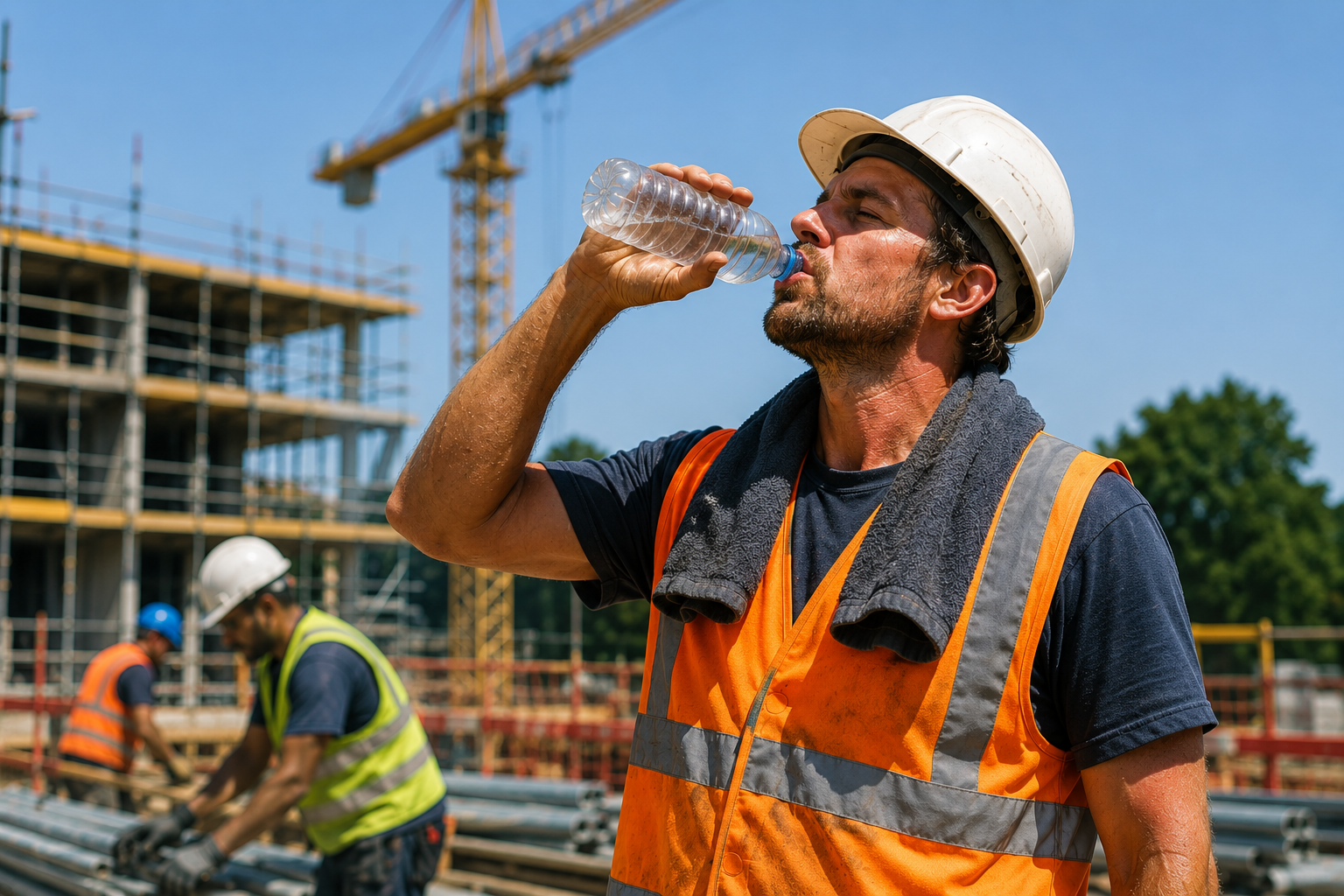

New data reveals the UK cities where tradespeople face the most dangerous working conditions and on which days the risk is highest, with August 12th statistically being the most dangerous day.
The Met Office recently announced that the UK has higher than normal chances of heatwaves this summer, yet the UK still has no legal maximum working temperature and outdoor workers have no enforceable right to stop work in extreme heat.
To highlight the risk, new research from tradesman insurance provider Protectivity has revealed where and when tradespeople face the most dangerous working conditions when the heat rises, with August 12th coming out as the most dangerous day of the year.
Analysing weather data across UK cities, the research identifies both the highest risk locations and the specific calendar dates most likely to put outdoor workers in danger.
When heat becomes a health hazard
Despite more than 100 million working hours estimated to be lost to heat stress across the British labour force, there is currently no legal maximum working temperature in the UK.
While other European countries enforce upper limits beyond which outdoor work must pause, UK employers are only required to maintain a ‘reasonable’ temperature, with no legal definition and no enforceable upper limit.
To reveal both the locations and the dates carrying the greatest risk, Protectivity analysed historical weather data where temperatures hit 27°C or above for at least two hours during the working day (6am–6pm).
The same data was then broken down by individual calendar date to reveal which days of summer are statistically most likely to see dangerous temperatures for outdoor workers, using the 27°C threshold that the TUC recommends strenuous outdoor work should stop at.
St Albans in Hertfordshire tops the table as the most dangerous city for tradespeople working outdoors in summer, recording an average of 47 days where temperatures reach dangerous levels during working hours.
Urban areas also face a compounded risk due to the ‘heat island effect’, where concrete, tarmac and traffic push temperatures up several degrees, as
London City comes in second place with 45 days of dangerous temperatures recorded, followed by Oxford (37) and Cambridge (37).
But it isn’t just where tradespeople work that increases their risk this summer, it’s also when. Across the full study period, August 12th stands out as the single most dangerous working day of the summer, registering a total of 61 days where the temperature reached 27°C over the last three years.
Expert insight: What tradespeople should be doing as temperatures climb
In a sector that is already at higher risk, with the construction industry recording the highest number of worker fatalities in recent years, preparing for safe working practices as temperatures rise is more crucial than ever.
For concerned tradespeople, James Crame, Health and Safety Advisor at Start Safety shares his top five tips to survive the summer:
1. Conduct a site heat risk assessment before temperatures rise
“Every site should have a documented heat risk assessment that identifies which tasks, roles and workers are most exposed. This should be updated at the start of each summer season and whenever new workers join. Key factors to assess include direct sun exposure by task type, PPE heat burden per role, access to shade and water, worker age and health status, and acclimatisation status.”
2. Implement an acclimatisation schedule for all new and returning workers
“The majority of heat fatalities occur in the first few days of hot conditions. New workers, those returning from holiday or sick leave, and workers new to physically demanding roles must be given a structured acclimatisation period by gradually increasing their exposure and workload over five to seven days.”
3. Reschedule strenuous outdoor tasks away from peak heat hours
“Outdoor task scheduling should be adjusted during periods of forecast heat. Strenuous physical work should be moved to early morning (before 10am) or late afternoon (after 4pm) wherever possible. UV radiation and ambient temperature are highest between 11am and 3pm so these hours should be avoided.”
4. Establish a structured work, rest and hydrate regime
“Telling workers to drink water is not a heat policy. A compliant heat management approach requires documented rest rotation schedules, with frequency increasing as temperature rises. Workers should be encouraged to hydrate every 15–20 minutes by drinking small amounts frequently, rather than large volumes infrequently. Shade structures or site welfare units should be positioned to allow genuine rest, away from radiated heat from plant, machinery and structure.”
5. Review and adapt PPE for heat conditions
“PPE selection in summer requires a review that asks if lighter, breathable alternatives could be used without compromising the required protection level. Vented hard hats, moisture wicking base layers, lightweight hi-vis, breathable gloves, and UV protective eyewear can all reduce heat burden without sacrificing compliance. Workers should be explicitly encouraged to remove PPE during rest breaks where it is safe to do so, to allow the body’s cooling systems to function.”
Chris Trotman, Underwriting Manager at Protectivity comments on the research: “What makes this research particularly striking is that the risk isn’t concentrated in one place or one month and it’s actually spread across cities many wouldn’t necessarily flag as heat hotspots, and it also starts earlier in the summer than most people would assume.
“Self-employed tradespeople in particular, who make up the largest self-employed workforce of any sector in the UK, have no employer to mandate rest breaks or enforce a heat policy on their behalf. The data makes clear this isn’t a niche risk and for tradespeople working outdoors right now, this is a very present and very real danger.”