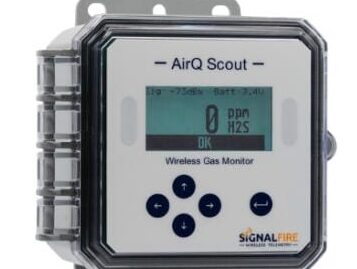

SignalFire has introduced the new AirQ Scout-LCD 900 MHz wireless gas detection system, expanding its AirQ product range following customer demand for local indication and visual alarming capabilities.
The AirQ Scout-LCD follows the successful launch of the original AirQ Scout in June 2025 and combines wireless gas monitoring with an integrated LCD display for real-time visibility in the field.
Designed for integration with SignalFire’s 900 MHz gateways, the device features a smart sensor capable of storing critical diagnostics directly on the sensor, including remaining sensor life, calibration history, and serial number information. All data can be accessed through the built-in LCD.
Predictive maintenance and remote connectivity
Pre-calibrated replacement sensors remove the need for field calibration, helping reduce maintenance time and operating costs. The system also supports predictive maintenance by providing continuous insight into sensor health.
The initial AirQ Scout-LCD release is configured to detect hydrogen sulfide, H₂S, concentrations from 0 to 100 ppm.
Future versions are expected to support carbon monoxide, carbon dioxide and lower explosive limit monitoring for combustible gases.
Wireless hazardous area gas detection
Operating on a 900 MHz licence-free ISM band radio, the AirQ Scout-LCD offers a wireless range of up to 0.5 miles, or 800 metres, making it suitable for remote or difficult-to-access locations without requiring trenching or wiring.
When paired with the PATRIoT Gateway, gas readings can be integrated into existing systems using Modbus RTU, Modbus TCP/IP, MQTT/Sparkplug, or EtherNet/IP. Data can also be monitored remotely through SignalFire Cloud.
The AirQ Scout-LCD is pending Class I, Division 1 intrinsically safe certification and is housed within an IP65-rated industrial polycarbonate enclosure with a field-replaceable long-life battery pack.
SignalFire’s General Manager, Josh Schadel, said: “The AirQ Scout-LCD is a direct response to what our customers have been asking for – greater visibility and simpler operation in the field.
“It integrates seamlessly with existing SignalFire gateways, making it easy to add gas detection points without costly wiring, while new sites can be quickly deployed and connected to SCADA and remote monitoring system.”