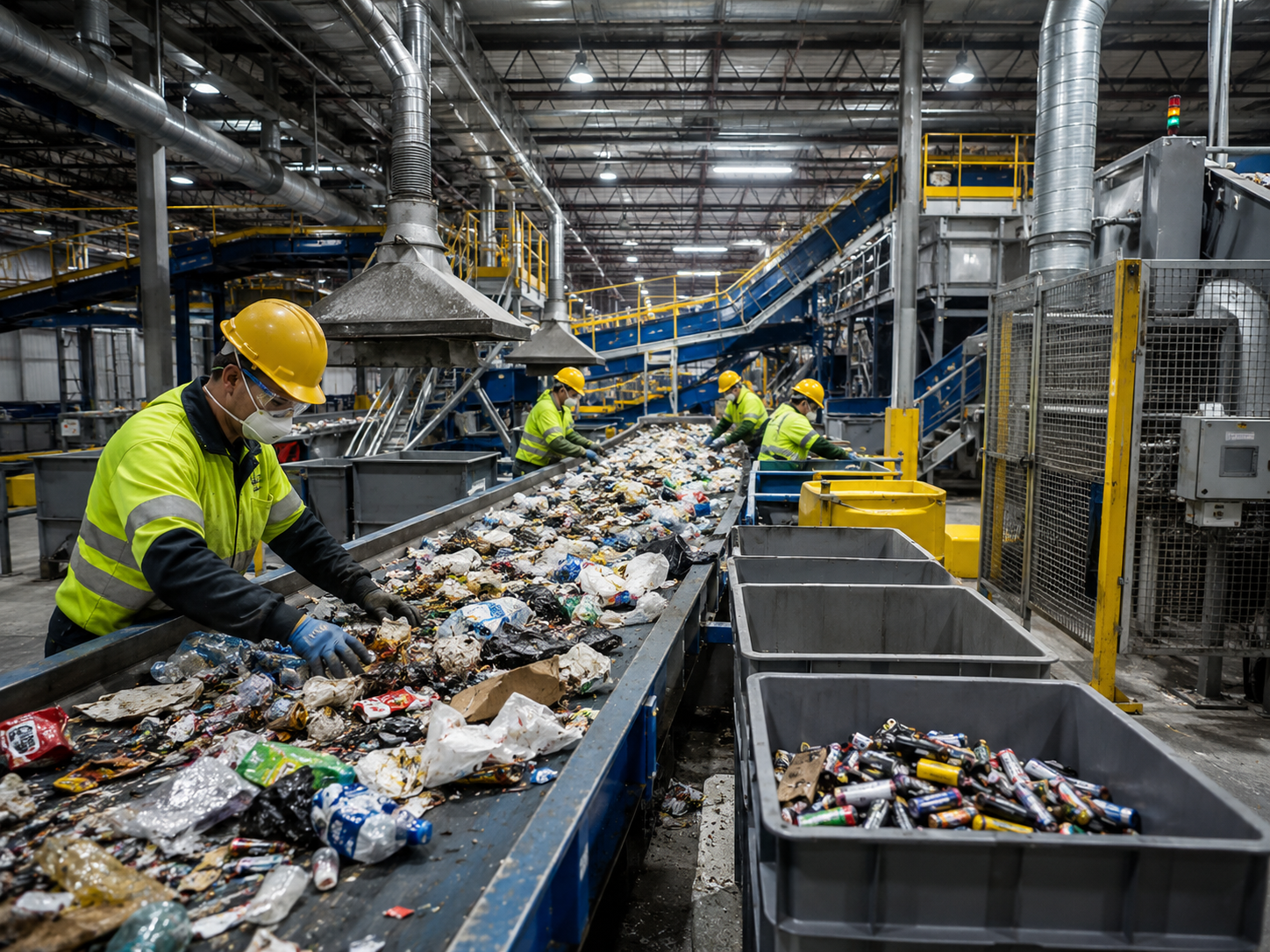

Katie Tracy examines how recycling facilities are confronting new workplace hazards as evolving waste streams demand safer processes, stronger risk management and continuous vigilance.
As recycling facilities handle a broader mix of materials than ever before, the risks facing workers continue to change. From lithium ion battery fires and hazardous dust to contaminated waste streams and ageing equipment, maintaining safe operations now depends on recognising hazards that are often hidden until conditions allow them to escalate.
The modern recycling industry sits at the centre of the circular economy. Governments continue to set ambitious recycling targets, manufacturers are incorporating greater volumes of recycled content into products, and consumers expect more waste to be recovered rather than sent to landfill. This shift has transformed recycling from a relatively straightforward process into one of the most technically demanding industrial environments.
Facilities that once handled largely predictable streams of paper, cardboard and metals now receive mixed municipal waste, construction materials, electrical equipment, textiles, plastics, batteries and products that were never designed with end of life processing in mind. Every incoming load presents a unique combination of materials, contaminants and unknowns.
For those responsible for health and safety, this changing landscape presents an equally complex challenge. Traditional hazards remain. Heavy mobile plant, conveyor systems, shredders, compactors and manual handling continue to account for many workplace injuries. Yet many of today’s most serious incidents stem from hazards that are difficult to detect until conditions deteriorate.
At the same time, operators must manage airborne contaminants generated during sorting and processing, exposure to biological agents carried in mixed waste streams, chemical residues from industrial materials and the cumulative effects of noise, vibration and repetitive work. Each hazard may appear manageable in isolation. Together they create a risk profile that demands constant review.
Perhaps the greatest challenge is that recycling itself continues to evolve faster than many safety strategies. As manufacturers develop new composite materials and consumer products become more complex, facilities must adapt to hazards that did not exist only a few years ago. Understanding those risks begins long before workers step onto the processing floor.
A changing waste stream means changing risks
Recycling operators have become accustomed to uncertainty. The composition of incoming waste varies daily, influenced by seasonal consumption, industrial activity and changes in public behaviour. That variability makes standardised risk management far more difficult than in many manufacturing environments.
Mixed loads may contain damaged electrical equipment, unidentified chemical containers, pressurised canisters or contaminated packaging hidden beneath otherwise recyclable materials. Even experienced operatives cannot always identify hazards before processing begins.
The growing volume of electronic waste has added another layer of complexity. Devices are becoming smaller, lighter and more integrated, making battery identification far more difficult during manual sorting. Small energy storage devices are also appearing in products that workers may not immediately associate with batteries, from children’s toys to power tools, electronic greeting cards and household appliances.
This places considerable emphasis on detection, monitoring and process design rather than relying solely on human observation.
Environmental monitoring has therefore become a far more important element of workplace safety. Conditions inside recycling facilities can change rapidly as materials are processed, particularly where dust concentrations fluctuate or enclosed processing areas experience changing ventilation requirements.
Monitoring equipment manufacturers such as Trolex have highlighted the importance of continuous environmental awareness across industrial workplaces where airborne hazards may not always be visible. Within recycling environments, understanding how dust behaves throughout different processing stages helps operators recognise developing risks before exposure reaches unacceptable levels.
Dust itself remains one of the industry’s least appreciated hazards. While explosions associated with combustible dust receive considerable attention, long term respiratory exposure often develops more gradually. Processing timber, plastics, paper, textiles and construction materials generates particles of varying sizes, many capable of remaining suspended within enclosed areas.
Exposure rarely results from a single event. Instead, it develops through repeated daily contact over months and years, reinforcing the importance of monitoring workplace conditions rather than responding only after visible accumulations appear.
Equally, air quality is becoming an operational issue as much as a compliance requirement. Solutions manufacturers including Air Spectrum Environmental emphasise how industrial workplaces are placing greater emphasis on controlling airborne contaminants before they spread throughout production areas. In recycling environments, where multiple processing activities occur simultaneously, maintaining effective extraction and filtration contributes not only to worker wellbeing but also to improved housekeeping and equipment reliability.
TO READ THE FULL ARTICLE, READ THE LATEST ISSUE HERE.