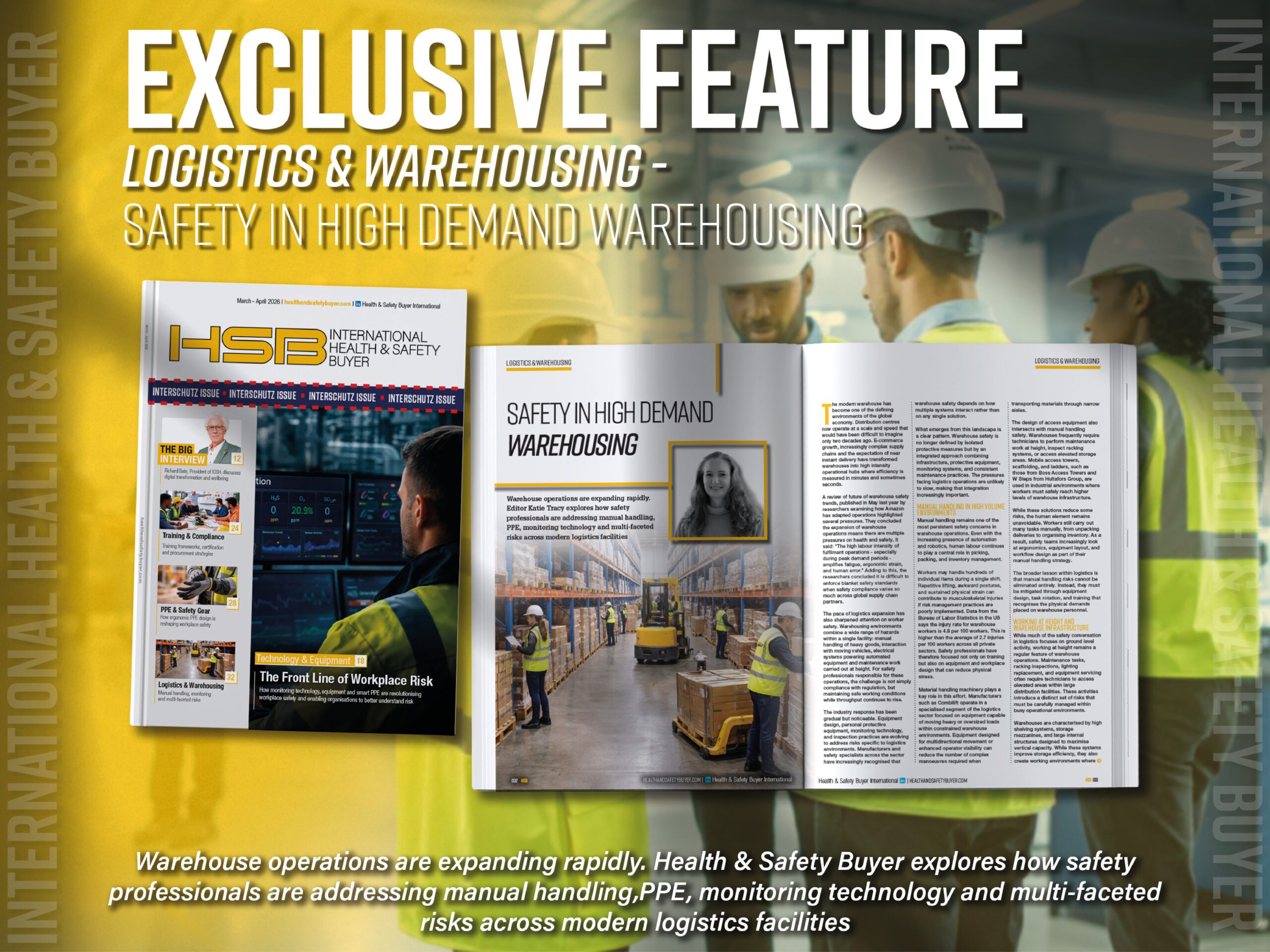

Warehouse operations are expanding rapidly. Editor Katie Tracy explores how safety professionals are addressing manual handling, PPE, monitoring technology and multi-faceted risks across modern logistics facilities.
The modern warehouse has become one of the defining environments of the global economy. Distribution centres now operate at a scale and speed that would have been difficult to imagine only two decades ago. E-commerce growth, increasingly complex supply chains and the expectation of near instant delivery have transformed warehouses into high intensity operational hubs where efficiency is measured in minutes and sometimes seconds.
A review of future of warehouse safety trends, published in May last year by researchers examining how Amazon has adapted operations highlighted several pressures. They concluded the expansion of warehouse operations means there are multiple pressures on health and safety. It said: “The high labour intensity of fulfilment operations – especially during peak demand periods – amplifies fatigue, ergonomic strain, and human error.” Adding to this, the researchers concluded it is difficult to enforce blanket safety standards when safety compliance varies so much across global supply chain partners.
The pace of logistics expansion has also sharpened attention on worker safety. Warehousing environments combine a wide range of hazards within a single facility: manual handling of heavy goods, interaction with moving vehicles, electrical systems powering automated equipment and maintenance work carried out at height. For safety professionals responsible for these operations, the challenge is not simply compliance with regulation, but maintaining safe working conditions while throughput continues to rise.
The industry response has been gradual but noticeable. Equipment design, personal protective equipment, monitoring technology, and inspection practices are evolving to address risks specific to logistics environments. Manufacturers and safety specialists across the sector have increasingly recognised that warehouse safety depends on how multiple systems interact rather than on any single solution.
What emerges from this landscape is a clear pattern. Warehouse safety is no longer defined by isolated protective measures but by an integrated approach combining infrastructure, protective equipment, monitoring systems, and consistent maintenance practices. The pressures facing logistics operations are unlikely to slow, making that integration increasingly important.
TO READ THE FULL ARTICLE READ THE LATEST ISSUE HERE.