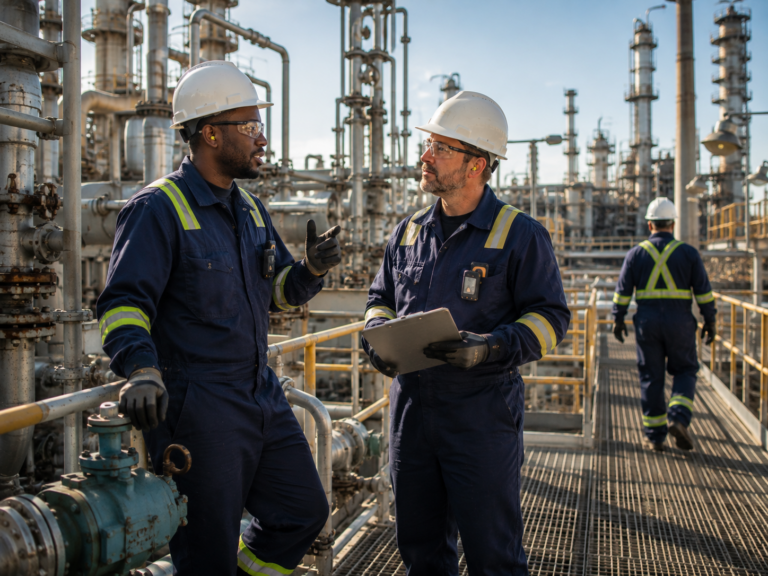
Exclusive Feature – The Rise of Intelligent Safety

Managing Editor Rebecca Spayne examines how AI and data driven platforms are transforming risk management as predictive safety rapidly becomes an operational reality.

Workplace safety has historically been defined by a backward glance. Organisations have relied on incident rates, audit findings, near miss reports, and regulatory inspections to determine the safety of an environment. This approach has served its purpose for decades, but it is no longer aligned with the realities of modern industrial work. Multi-site operations, complex supply chains, rapid workforce turnover, and the presence of hazardous materials have made reactive compliance insufficient.

Digital transformation has now pushed the industry towards a different logic. Predictive safety management uses real time data, sensor enabled monitoring, and AI enhanced analytics to identify risks before they escalate. Rather than waiting for an incident to confirm the presence of a problem, organisations can intervene earlier, with decisions supported by evidence rather than assumption.

For many professionals, the shift can feel daunting. The scale of data involved, the integration of new platforms, and the cultural change required all contribute to a sense of unease. Yet the direction is clear. Predictive safety does not eliminate human judgement. Instead, it strengthens the foundations on which that judgement is made.

Across this transition, several companies have played important roles in shaping the market. From advanced gas detection devices to connected worker platforms and wearable sensors, these technologies are part of a wider movement towards proactive risk intelligence.

Real Time Monitoring and Prediction

Predictive safety management cannot exist without reliable data streams. Real time monitoring has become the industry’s most important source of data, particularly in environments involving hazardous gases, confined spaces, chemical exposure, or remote lone working.

Industrial Scientific has been at the centre of this shift, with connected gas detection devices that combine environmental monitoring with cloud-based analytics. Their solutions reflect a fundamental truth about predictive safety; information loses value the moment it becomes outdated. Industrial Scientific’s approach integrates live data feeds into digital platforms that allow safety teams to assess trend patterns, detect anomalies, and understand how conditions are evolving across a large operational footprint.

Gas Clip Technologies has focused on reliability in challenging environments where false alarms or inconsistent readings become safety risks in their own right. Their multi gas and single gas devices are designed for extended run times and continuous monitoring in harsh conditions. This is significant for predictive safety because dependable baseline readings improve the accuracy of any subsequent analytics. Without trustworthy data, predictive models become skewed and potentially misleading.

The importance of accurate and continuous detection extends beyond gas. Dräger’s long standing presence across respiratory protection, gas detection, and environmental monitoring demonstrates how diverse data sources can be unified. Predictive safety is not about a single device or a single metric. It depends on an ecosystem of information that reflects how workers move, how processes behave, and how environments change across a shift.

TO READ THE FULL ARTICLE READ THE LATEST ISSUE HERE.

About International Health & Safety Buyer

Health & Safety Buyer is the premier global voice of the health and safety industry, providing expert coverage, in-depth features, exclusive interviews, and valuable insights across print, digital, and event platforms. Published 6 times a year, the magazine is a trusted source for professionals looking to stay informed on the latest innovations, trends, and business developments in the health and safety sector.

To contribute an article or explore sponsorship opportunities, please get in touch with our team below.

Katie Tracy picture

Katie Tracy

Editor

Chris Lingham picture

Chris Lingham

Group Sales Manager

Afua Akoto Picture

Afua Akoto

Marketing Manager

Read the Latest Issue

Health & Safety Buyer International reveals July-August 2026 issue

July-August 2026

Advertise here

Reach decision makers and amplify your marketing

Advertise here

Click Here

Follow us on LinkedIn

Follow us on LinkedIn

Click Here

Related News

Survey finds gaps in SME risk assessments. healthandsafetybuyer.com

Survey finds gaps in SME risk assessments

More than half of small and medium sized enterprises carry out risk assessments, according to initial findings from Germany’s Federal Institute for Occupational Safety and Health (BAuA)
Meeting future PPE challenges. healthandsafetybuyer.com

Meeting future PPE challenges

PPE innovation are improving protection and thermal comfort in industrial settings across diverse sectors.
Chris Allcard, Reliance Protect.healthandsafetybuyer.com

Safety Brief – Chris Allcard

Chris Allcard, Director of Reliance Protect, explores how connected technology is transforming lone worker protection and empowering safer workplaces in our Safety Brief Q+A.
Rethinking Remote Worker Safety. healthandsafetybuyer.com

Supporting Remote Energy Workers

As organisations seek greater consistency across international operations, the focus is shifting from documentation towards demonstrable performance.
Aligning Worldwide Safety Standards. healthandsafetybuyer.com

Training and workforce competence  

Training represents one of the most significant challenges facing international employers.
Aligning Worldwide Safety Standards. healthandsafetybuyer.com

Aligning Worldwide Safety Standards 

As organisations expand internationally, aligning workplace safety standards across different regulatory frameworks remains one of compliance’s greatest ongoing challenges.
Rethinking Remote Worker Safety. healthandsafetybuyer.com

Rethinking Remote Worker Safety  

Katie Tracy examines how connected worker technologies are helping energy operators improve lone worker safety, emergency response and operational visibility across remote sites. 
Hidden Hazards in Recycling. healthandsafetybuyer.com

PPE Protection for Recycling

While engineering controls remain the first line of defence, personal protective equipment continues to play a vital role in reducing exposure when hazards cannot be eliminated entirely.
Fire resistant workwear is evolving to deliver certified protection alongside greater comfort, durability and mobility for demanding workplaces. Rebecca Spayne reports. healthandsafetybuyer.com

The Evolution of Flame Resistant PPE

Manufacturers now examine how garments move with the body, how seams perform under repeated stretching and how articulated construction supports natural movement.
Fire resistant workwear is evolving to deliver certified protection alongside greater comfort, durability and mobility for demanding workplaces. Rebecca Spayne reports. healthandsafetybuyer.com

Beyond Basic Flame Protection

Fire resistant workwear is evolving to deliver certified protection alongside greater comfort, durability and mobility for demanding workplaces. Rebecca Spayne reports.
Scroll to Top