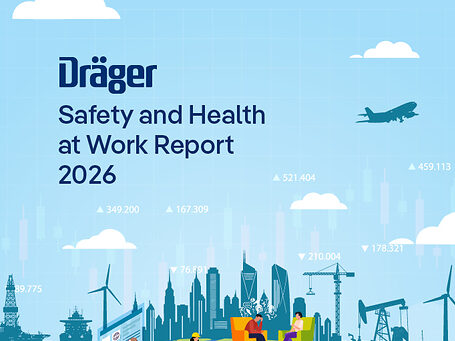

New research published as part of the annual Dräger Safety & Health at Work Report has revealed growing concern about workplace safety, with more than half of respondents believing the risk of a major industrial disaster is now higher than it was a decade ago.
Rising fears of industrial disasters
The sixth edition of the annual report, based on independent research commissioned by Draeger Safety UK, part of The Dräger Group, found that 53% of respondents believe the likelihood of a major industrial incident in their sector has increased over the last ten years.
The report also highlighted a rise in workplace near misses, with 51% of those surveyed reporting that such incidents have increased over the past two years.
Global uncertainty impacting safety
According to the findings, global instability is contributing significantly to workplace safety challenges.
Almost three quarters of respondents, 72%, said supply chain disruptions have made it harder to obtain parts, materials and support.
Meanwhile, 69% reported that global uncertainty has increased stress and fatigue among workers, contributing to errors and unsafe behaviours.
Frequent organisational changes and shifts in business strategy, often driven by external pressures, are also making safety management more difficult, according to 61% of respondents.
Frontline workers raise concerns
The report identified staff fatigue, growing workloads, rising stress levels and a reluctance among employees to speak up about concerns as key factors behind the increase in near misses.
Perhaps most notably, 63% of frontline workers said their employers do not fully understand the extent of safety challenges being experienced on the ground.
Matthew Bedford, Managing Director, Draeger Safety UK, said: “Over the past six years, the landscape of workplace health and safety has continued to shift, shaped by the immediate disruption of the pandemic, ongoing financial pressures, global instability, and changing workforce expectations as new generations enter employment.
“The findings of the 2026 report reflect a wider environment of ongoing global uncertainty and volatility, and concerningly, suggest that the ‘perfect storm’ of factors affecting workplace safety and health, as highlighted in last year’s report, may be closer to becoming reality than is comfortable.
“If there is one clear message for health and safety professionals, it is that the warning signs are now unmistakable. It is imperative that organisations listen and act.”